
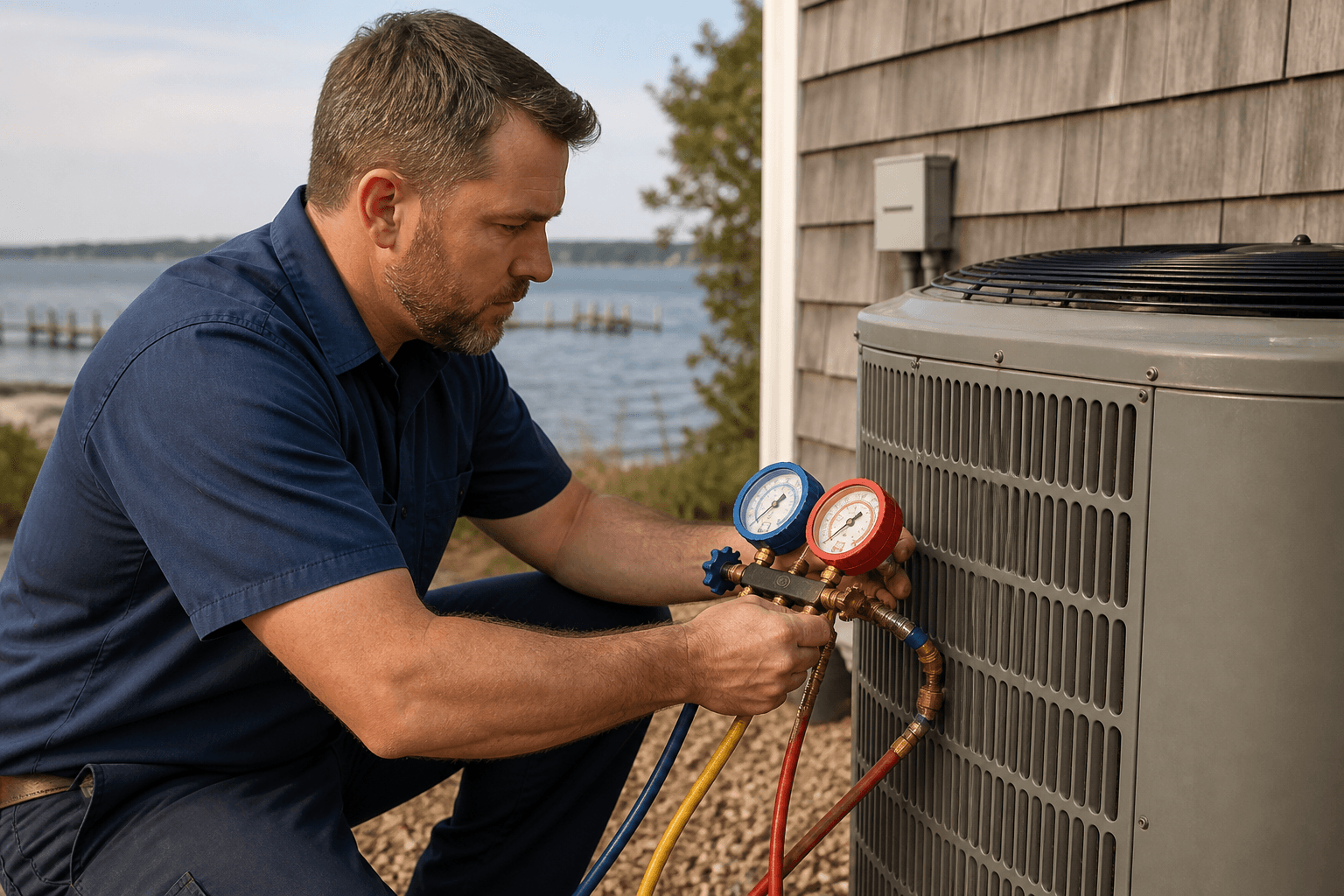
If your central air or heat pump was installed anytime in the last fifteen years, there is a good chance it runs on R-410A. You have probably seen headlines about refrigerants being “banned” or “phased out,” and if you own a shore property, where systems run longer hours in humidity and salt air, it is fair to wonder whether you are about to be pushed into an expensive replacement.
The short answer: nobody is making you throw away equipment that still works. What changed is what manufacturers can build new, what refrigerants new systems use, and how contractors should talk to you when a coil leaks in July.
Three facts that cut through the noise
First, R-410A service refrigerant is not illegal. The AIM Act phases down production over time; it does not outlaw repairing the system on your wall.
Second, new residential split systems could no longer be manufactured with R-410A after January 1, 2025. That affects what your contractor can order, not whether we can legally work on what you already own.
Third, enforcement around installing leftover R-410A equipment shifted in early 2026. EPA has signaled a path to allow installation of pre-2025 inventory until stock is depleted, while some states (notably New York) remain stricter. New Jersey shore homeowners should confirm what generation of equipment is on the quote before approving a full changeout.
R-454B, R-32, and why “just recharge it” is not always simple
Replacement equipment is moving toward lower-global-warming refrigerants such as R-454B and R-32. They are not drop-in substitutes for R-410A. Different oils, pressures, and safety hardware mean you do not convert an aging board-and-coil system in the field. You replace the matched outdoor and indoor components designed for the new refrigerant class.
If a technician proposes topping off a fifteen-year-old R-410A system with a “newer” refrigerant without a manufacturer-approved retrofit, that is a red flag. Get a second opinion.
On the other hand, if your system holds charge, delivers stable temperatures, and passes a sensible inspection, keeping it is a legitimate choice. Replacement becomes the better move when leak history, compressor wear, or obsolete parts availability make the next repair a band-aid.
Why the shore changes the math
Barrier-island and bayside homes punish outdoor equipment: salt mist, tight setbacks, rooftop pads, and shoulder-season humidity that keeps condensers running when inland systems have already idled. A slow leak that might buy two seasons in Morris County can become an emergency in August on Long Beach Island.
That is an equipment economics question, not a regulatory mandate. We see homeowners make good decisions both ways: nursing a sound R-410A system through another season with honest leak detection, or stepping into a current-generation heat pump when rebates and efficiency gains align.
Questions worth asking before you sign
What refrigerant is this system designed for today, and what would a replacement use? Will the quote include line-set flushing or a full matched system per manufacturer spec? If there is a leak, are we locating it or only adding gas?
Spring remains the best window for a tune-up along the Brick–Margate corridor: filters, pressures, drains, and a straight answer on whether your current unit is worth another summer. Waiting until the first heat wave fills routes fast.
Last updated May 23, 2026